AI & SEO
Maintaining Search Visibility in the Age of AI

Crescent Technologies pk
·8 min read
Want to know if your site has this issue? Run a free technical SEO audit and get results in minutes.
Run a Free SEO Audit →Key Takeaways
Search engine optimization is no longer limited to ranking web pages for traditional search engines. The digital landscape is rapidly shifting toward AI-driven discovery systems where intelligent assistants, autonomous agents, conversational search engines, recommendation engines, and generative AI platforms are becoming primary gateways to information.
Businesses, publishers, startups, and content creators now face a new challenge: how to remain continuously discoverable when users increasingly rely on AI systems instead of manually browsing search results.
This transformation is changing the foundations of SEO. Traditional optimization strategies focused mainly on keywords, backlinks, metadata, and ranking positions. Modern discoverability, however, requires websites and brands to become understandable, trustworthy, machine-readable, context-rich, and continuously relevant for AI systems capable of reasoning, summarizing, and making decisions autonomously.
The rise of agentic AI introduces a completely new environment where intelligent systems can independently search, compare, analyze, summarize, and even act on behalf of users. In this environment, visibility is no longer about appearing on page one of a search engine. It is about becoming a reliable source that AI systems repeatedly select, reference, trust, and recommend.
This article explores how businesses can ensure long-term discoverability through advanced SEO practices designed specifically for the era of agentic AI.
For decades, search worked through a relatively predictable process. A user entered a query, a search engine indexed web pages, algorithms ranked results, and the user clicked links.
Agentic AI changes this interaction completely.
Modern AI systems are increasingly capable of:
Understanding natural language deeply
Interpreting user intent
Combining information from multiple sources
Making recommendations
Performing actions autonomously
Learning contextual preferences
Refining answers dynamically
Executing multi-step reasoning
Instead of users manually comparing ten search results, AI agents can now evaluate hundreds of pages in seconds and deliver synthesized answers.
This means visibility is no longer determined solely by ranking position. AI systems prioritize:
Authority
Semantic clarity
Trustworthiness
Contextual depth
Structured information
Freshness
Brand credibility
Consistency across platforms
The organizations that adapt early to this transition will gain long-term competitive advantages.
Agentic AI refers to intelligent systems capable of independently performing tasks, making decisions, planning workflows, and interacting with digital environments with minimal human supervision.
Unlike conventional chatbots that simply respond to prompts, agentic AI systems can:
Set goals
Perform research
Compare alternatives
Retrieve information
Validate sources
Execute workflows
Continuously refine outputs
Interact with APIs and tools
Navigate websites autonomously
Examples include advanced AI assistants, autonomous research agents, AI-powered recommendation systems, AI shopping assistants, and enterprise automation agents.
These systems increasingly influence how users discover brands, products, services, and information online.
As AI agents become intermediaries between users and the web, SEO strategies must evolve accordingly.
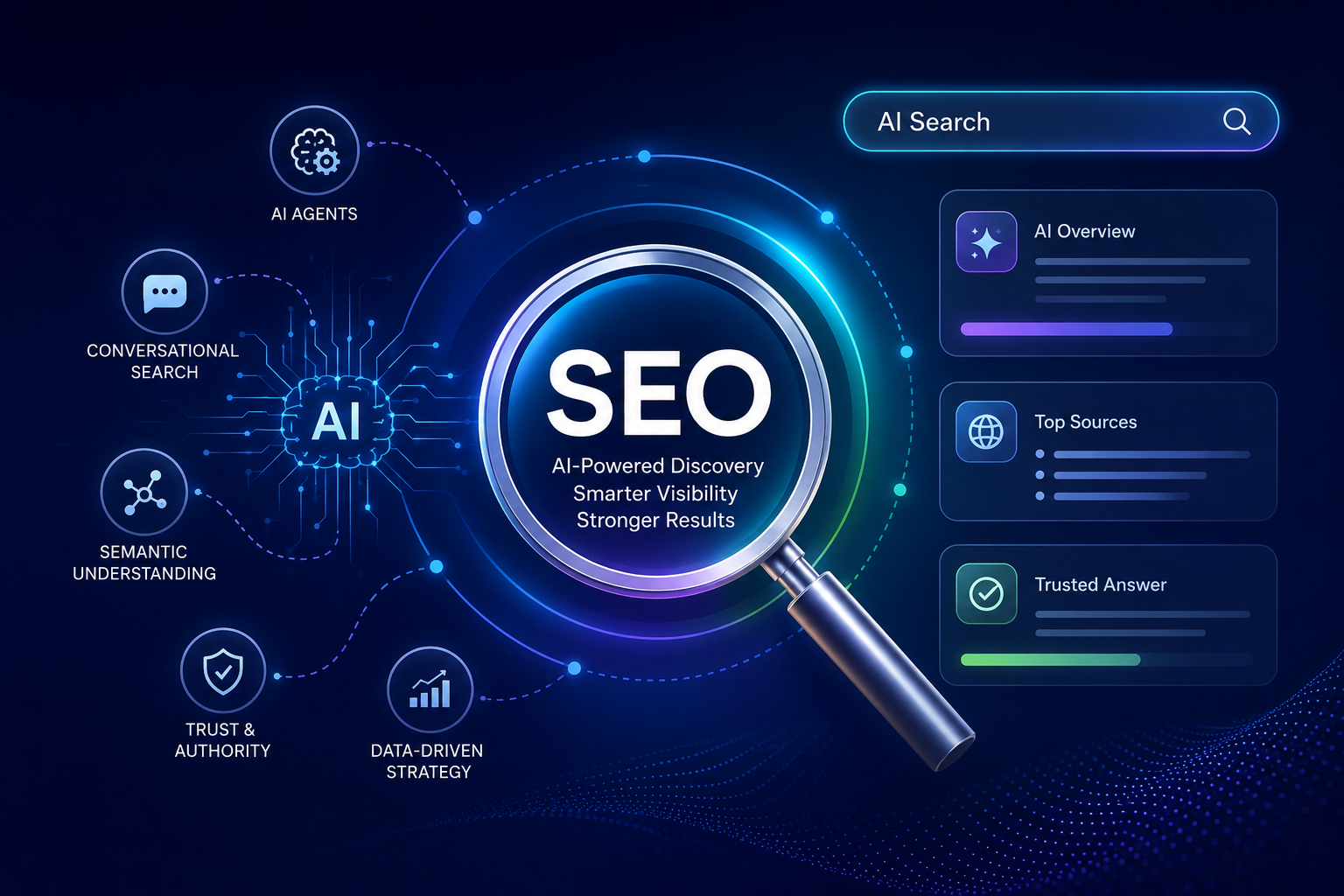
Traditional SEO still matters. Technical optimization, content quality, backlinks, and user experience remain important foundations. However, they are no longer sufficient on their own.
Several major changes are reshaping discoverability:
Users are shifting from keyword-based queries toward conversational interactions. Instead of typing:
“best project management software”
Users now ask:
“What is the best project management platform for remote software teams with under 50 employees?”
AI systems interpret nuanced intent rather than matching exact keywords.
Generative search experiences increasingly provide direct answers within search interfaces. Users often receive summarized information without clicking websites.
This creates a new challenge:
How can brands remain visible even when traffic patterns change?
The answer lies in becoming a trusted source repeatedly cited and interpreted by AI systems.
Modern discovery includes:
Voice search
Conversational AI
Visual search
AI assistants
Recommendation systems
Smart devices
Autonomous workflows
SEO must now optimize content for multiple discovery environments simultaneously.
Traditional SEO often rewarded keyword targeting. AI systems instead prioritize semantic understanding.
They analyze:
Relationships between entities
Topical authority
Knowledge consistency
Contextual relevance
Credibility indicators
Source reliability
This requires a more intelligent content architecture.
To remain continuously discoverable in the AI era, businesses must focus on several foundational principles.
Semantic authority means covering topics comprehensively and meaningfully rather than targeting isolated keywords.
AI systems evaluate whether a website demonstrates deep expertise across an entire subject area.
For example, a cybersecurity company should not only publish articles targeting “malware protection.” It should also cover:
Threat detection
Endpoint security
Zero trust architecture
Phishing prevention
Network security
Cloud vulnerabilities
Security compliance
Incident response
AI-driven cyber threats
Comprehensive topical coverage signals expertise to AI systems.
AI systems rely heavily on structured information.
Schema markup, metadata, semantic HTML, and organized content structures help AI agents understand:
Products
Services
Reviews
Organizations
Events
Authors
FAQs
Articles
Pricing
Locations
Relationships between entities
Without structured data, even high-quality content may become difficult for AI systems to interpret accurately.
Experience, Expertise, Authoritativeness, and Trustworthiness are becoming increasingly important.
AI systems evaluate signals such as:
Verified authors
Expert citations
Transparent sourcing
Updated content
Brand reputation
Domain consistency
User engagement
Positive external references
Trust is becoming one of the most critical ranking and discoverability factors.
Agentic AI systems prefer current, reliable, and updated information.
Static websites gradually lose relevance.
Modern SEO requires:
Continuous content updates
Trend monitoring
Timely industry insights
Regular audits
Updated statistics
Refreshed case studies
Freshness signals ongoing authority.
AI systems process content conversationally.
This means content should naturally answer real-world questions rather than relying excessively on robotic keyword repetition.
Effective conversational optimization includes:
Natural language
Direct answers
Contextual explanations
Follow-up question coverage
Problem-solving structures
Intent-focused writing
The goal is to align with how humans actually communicate.
AI retrieval systems analyze information differently from traditional crawlers.
To optimize for retrieval-based AI models:
Content should include logical structures such as:
Main topics
Supporting subtopics
Contextual explanations
Definitions
Related concepts
This improves semantic interpretation.
AI systems often retrieve content fragments independently.
Each section should provide complete contextual meaning without requiring excessive surrounding explanation.
Thin content performs poorly in AI-driven environments.
High-value content includes:
Examples
Context
Definitions
Insights
Data
Practical explanations
Actionable guidance
Depth improves retrievability.
Clear language helps AI systems interpret content correctly.
Avoid:
Excessive jargon without explanation
Unclear references
Vague terminology
Overly complex sentence structures
Clarity enhances machine understanding.
Technical SEO remains foundational, but its priorities are evolving.
AI systems require reliable access to content.
Fast page speed
Mobile responsiveness
Clean architecture
Accessible HTML
Proper indexing
XML sitemaps
Secure HTTPS protocols
Poor technical infrastructure limits discoverability.
As agentic systems interact increasingly through APIs and machine interfaces, structured content delivery becomes critical.
Businesses may need:
Knowledge APIs
Structured product feeds
Public data endpoints
AI-readable documentation
Machine accessibility is becoming a strategic advantage.
Modern search increasingly revolves around entities rather than keywords.
An entity may represent:
A person
A company
A product
A location
A concept
AI systems connect entities through contextual relationships.
Businesses should strengthen:
Brand identity consistency
Structured organization data
Knowledge graph presence
Cross-platform references
Entity associations
Strong entity recognition improves discoverability across AI ecosystems.
Superficial content struggles in modern search environments.
Agentic AI systems prefer sources demonstrating deep expertise.
High-performing content often includes:
Comprehensive explanations
Real-world examples
Expert insights
Industry perspectives
Comparative analysis
Detailed workflows
Problem-solving frameworks
Long-form educational content is increasingly valuable because it offers richer contextual signals.
As generative AI systems summarize and reference sources, businesses should optimize for citation potential.
This involves:
AI systems value unique information.
Original research, case studies, surveys, and proprietary data improve citation probability.
Clear factual statements are easier for AI systems to extract and reference.
Authoritative perspectives increase perceived expertise.
Citations favor trustworthy and accurate sources.
Errors reduce long-term visibility.
In AI-driven search environments, brands matter more than ever.
AI systems tend to prioritize recognizable, trustworthy, and established sources.
Brand authority is influenced by:
Industry recognition
Mentions across trusted websites
Social proof
Media references
Consistent publishing
Expert contributions
User trust signals
SEO is increasingly becoming interconnected with digital branding and reputation management.
AI systems analyze user interaction signals to evaluate content quality.
Poor user experiences negatively affect discoverability.
Crucial UX factors include:
Fast loading speed
Easy navigation
Clear readability
Mobile optimization
Accessible design
Logical structure
Reduced friction
A website optimized for humans is often easier for AI systems to evaluate positively.
Voice-based discovery continues growing through smart assistants and conversational interfaces.
Voice optimization requires:
Natural language phrasing
Question-answer formatting
Concise responses
Local relevance
Conversational structure
AI assistants frequently prioritize sources capable of delivering direct, understandable answers.
Local discoverability is also changing significantly.
AI agents increasingly recommend nearby businesses based on:
Reviews
Reputation
Consistency
Service quality
Structured business information
Businesses should maintain:
Accurate local listings
Updated contact details
Review management
Local schema markup
Consistent NAP information
Local trust signals strongly influence AI recommendations.
Knowledge graphs help AI systems understand relationships between entities.
Modern SEO increasingly depends on becoming part of interconnected knowledge ecosystems.
Businesses can strengthen knowledge graph visibility through:
Structured data
Consistent branding
Wikidata references
Industry citations
Author pages
Organizational transparency
Knowledge graph integration improves semantic discoverability.
Agentic AI systems increasingly personalize recommendations based on user context.
This means discoverability may vary between users.
Businesses should create content serving multiple intent categories, including:
Informational intent
Transactional intent
Navigational intent
Comparative intent
Educational intent
Broader intent coverage increases visibility opportunities.
SEO is no longer limited to websites.
AI systems gather signals from multiple ecosystems including:
Social platforms
Forums
Video platforms
Podcasts
Documentation portals
News sources
Community discussions
Brands should maintain consistent authority across channels.
The rise of generative AI has created massive content saturation.
Low-quality AI-generated content floods search ecosystems daily.
As a result, AI systems increasingly reward:
Human expertise
Original thinking
Unique insights
Real-world experience
Authenticity
Accuracy
Simply mass-producing AI-written articles is no longer sustainable.
Successful brands combine AI efficiency with human expertise.
Topic clusters help establish authority.
A strong content ecosystem may include:
Pillar pages
Supporting articles
Tutorials
Case studies
FAQs
Industry insights
Technical documentation
Interconnected content improves semantic depth and discoverability.
Businesses should monitor not only traditional rankings but also AI visibility indicators.
Major areas include:
AI citation frequency
Brand mentions in generative search
Knowledge panel presence
Conversational search visibility
Featured snippet inclusion
Voice assistant recommendations
SEO analytics must evolve alongside AI discovery systems.
Manipulative SEO tactics become increasingly risky in AI-driven environments.
AI systems are becoming better at detecting:
Keyword stuffing
Content farms
Misleading claims
Spam tactics
Artificial authority
Ethical optimization focused on value creation is becoming the most sustainable long-term strategy.
Several emerging trends will shape the future of SEO:
AI agents may independently compare products and make purchasing decisions on behalf of users.
AI systems may anticipate user needs before explicit searches occur.
Discovery experiences will increasingly adapt to individual contexts and behaviors.
AI systems may continuously reevaluate source quality dynamically.
Future ecosystems may involve direct interactions between autonomous systems and business infrastructures.
Organizations preparing early for these developments will remain more resilient.
To maintain long-term discoverability, businesses should focus on:
Publishing authoritative long-form content
Building semantic topical depth
Improving structured data implementation
Maintaining technical SEO excellence
Investing in brand authority
Enhancing user experience
Updating content regularly
Strengthening entity recognition
Creating original research
Optimizing for conversational search
Expanding multi-platform presence
Monitoring AI visibility metrics
Consistency is essential.
AI-driven discoverability is not achieved through isolated tactics. It requires a comprehensive ecosystem approach.
Despite rapid AI advancement, human value remains central.
AI systems increasingly prioritize content demonstrating:
Real expertise
Genuine experience
Authentic perspectives
Practical insights
Human understanding
The future of SEO is not about replacing humans with AI.
It is about combining intelligent automation with meaningful human knowledge.
To get more information about the SEO , please click here
See exactly how this affects your site — our audit surfaces issues like these in minutes.
Check your site for this issue →Final Thoughts
The evolution from traditional search engines to agentic AI ecosystems represents one of the most significant transformations in digital discoverability. Businesses can no longer rely solely on conventional SEO tactics focused narrowly on rankings and keywords. Modern discoverability requires a deeper understanding of how AI systems retrieve, evaluate, synthesize, and recommend information. Success in this new landscape depends on becoming a trusted, authoritative, semantically rich, and machine-understandable source across multiple digital environments. Organizations that invest early in AI-centric SEO strategies will build stronger resilience against changing algorithms, evolving search interfaces, and shifting user behaviors. The future belongs to brands that can consistently provide clarity, expertise, trust, and value not only to human audiences, but also to the intelligent systems increasingly guiding digital discovery. As AI agents continue transforming how information is accessed and decisions are made, continuous discoverability will become one of the most valuable competitive assets in the digital world.
FAQ
Free tool
Get a full technical, performance, and AI SEO audit — prioritized and ready to act on. No credit card required.