Technical SEO : Fix the Errors Killing Your Rankings

Mubashira
·8 min read
Want to know if your site has this issue? Run a free technical SEO audit and get results in minutes.
Run a Free SEO Audit →Key Takeaways
- Crawl errors and blocked resources prevent Google from indexing your most valuable pages.
- Core Web Vitals scores directly influence rankings — LCP under 2.5s is the 2026 standard.
- Duplicate content and missing canonical tags split your ranking signals across multiple URLs.
- Structured data markup unlocks rich results that significantly boost click-through rates.
- Monthly technical audits catch silent ranking killers before they compound into major losses.
Why Technical SEO Errors Are More Costly in 2026 Than Ever Before
You've published great content. You've built backlinks. You've optimised your meta titles and descriptions. And yet — your rankings are flat, your traffic isn't growing, and you can't figure out why.
The answer is almost always buried in your technical SEO. Hidden crawl errors, misconfigured redirects, broken canonical tags, and slow-loading pages are silently undermining every other SEO effort you make. In 2026, Google's algorithms are more precise than ever — and they have zero tolerance for sites that make crawling, indexing, or ranking difficult.
This guide breaks down the most damaging technical SEO errors active on sites right now, explains exactly why they hurt your rankings, and shows you how to fix them systematically. Whether you manage one site or fifty, this is the technical SEO framework that moves the needle.
Why Technical SEO Errors Are More Costly in 2026 Than Ever Before
Google processes billions of pages daily through its crawl infrastructure. As the web grows, Googlebot has become increasingly selective about how it allocates crawl budget. If your site is loaded with technical errors, Googlebot wastes that budget on broken pages, redirect chains, and duplicate URLs instead of discovering and indexing your best content.
The Compounding Effect of Unresolved Technical Debt
Technical SEO problems rarely stay isolated. A missing XML sitemap means Google discovers your pages more slowly. Slow discovery means fewer pages indexed. Fewer indexed pages means less organic traffic. Less traffic means fewer signals for Google to assess quality — which depresses rankings further. One overlooked error compounds into a chain of ranking consequences that can take months to reverse.
What Has Changed in Google's Technical Requirements for 2026
The shift from First Input Delay (FID) to Interaction to Next Paint (INP) as an official Core Web Vitals metric is now fully embedded in Google's ranking systems. Sites that haven't updated their performance monitoring to track INP are flying blind on a live ranking signal. Google's updated Core Web Vitals documentation confirms that field data from real users — not just lab scores — is what influences rankings.
The 6 Technical SEO Errors Most Likely Killing Your Rankings
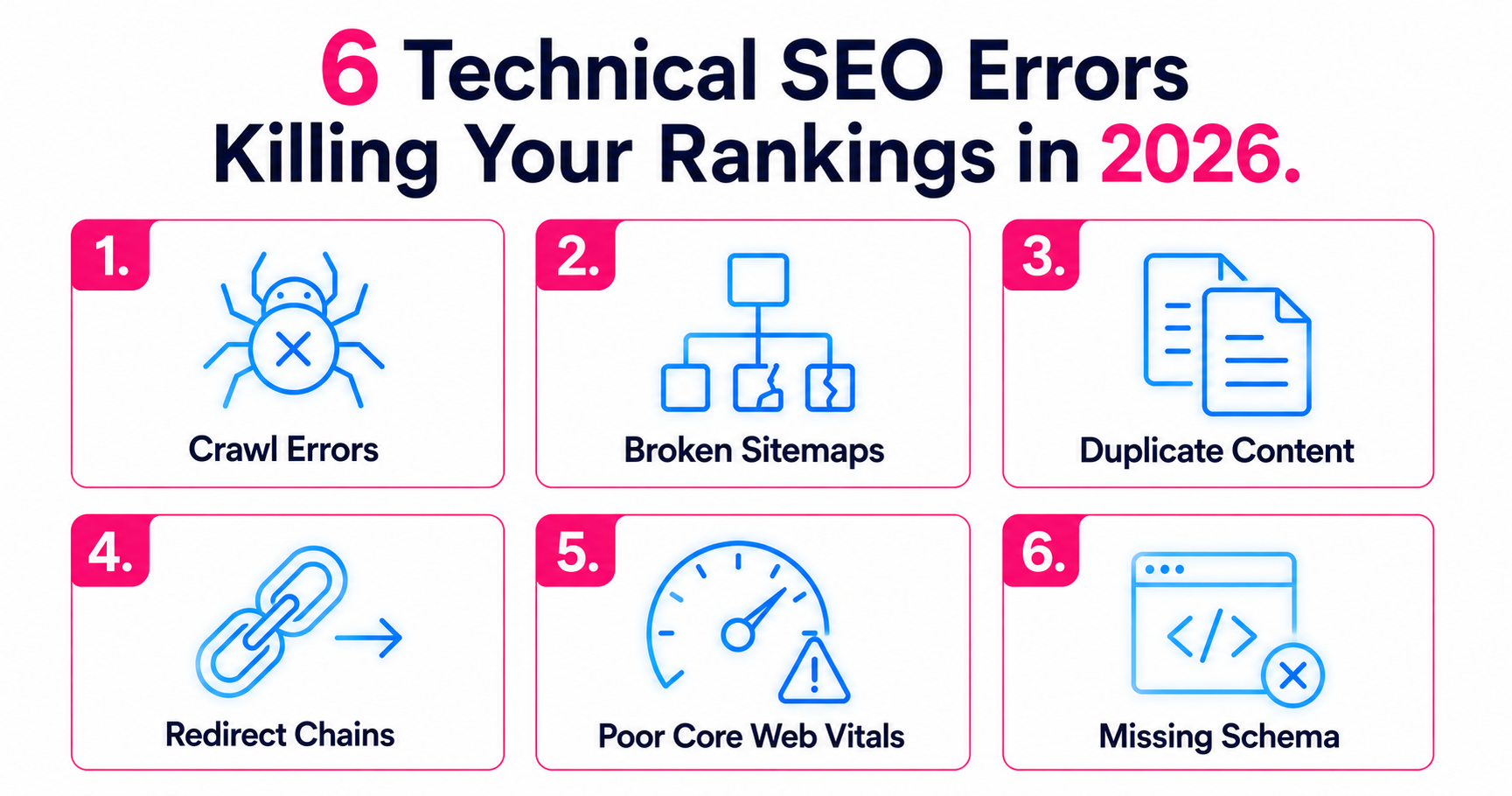
These are the issues found most frequently in professional SEO audits — and the ones with the highest direct impact on rankings and organic traffic.
Crawl Errors and Blocked Resources
A 4xx error means a page doesn't exist or can't be accessed. A 5xx error means your server failed to respond. Both waste Googlebot's crawl budget and bleed link equity into dead ends. Resources blocked via robots.txt — CSS files, JavaScript files, images — can prevent Google from rendering your pages correctly, which distorts how your content is understood and ranked.
Run a full crawl using SEO Reporty's site audit tool to map every 4xx and 5xx error, every blocked resource, and every internal link pointing to a broken URL. Fix critical errors first: restore or redirect broken pages that carry backlinks, unblock essential rendering resources, and update internal links to point to live canonical URLs.
Missing or Broken XML Sitemaps
Your XML sitemap is the map you hand Googlebot when it arrives at your site. A missing sitemap means Google relies entirely on link discovery — a slower process that leaves new content unfound for days or weeks. A broken sitemap containing 404 URLs, noindexed pages, or redirect URLs actively misleads the crawler. Your sitemap should contain only canonical, indexable, 200-status URLs. Submit it directly in Google Search Console and monitor the Coverage report weekly.
Duplicate Content and Canonical Tag Errors
When the same content is accessible at multiple URLs — through URL parameters, pagination, session IDs, or HTTP/HTTPS variants — Google splits your ranking signals across multiple versions instead of consolidating behind one authoritative URL. The rel="canonical" tag tells Google your preferred URL. Every page on your site should have a self-referencing canonical tag, and duplicate pages must point their canonical to the original using absolute URLs.
Redirect Chains and Redirect Loops
A redirect chain occurs when URL A redirects to URL B, which redirects to URL C. Every hop costs crawl budget, dilutes PageRank, and slows page load time. A redirect loop — where the chain circles back to a URL already in the sequence — breaks the page entirely. The fix is always to update redirects to point directly from the original URL to the final destination in a single 301. Never let a chain persist because it "technically works" — the authority and performance cost is real and measurable.
Poor Core Web Vitals — Especially on Mobile
Core Web Vitals are an active ranking signal. The three metrics — Largest Contentful Paint (LCP), Interaction to Next Paint (INP), and Cumulative Layout Shift (CLS) — measure real user experience on your pages. Google uses field data from the Chrome User Experience Report (CrUX) to assess your scores, meaning your actual users' experiences feed directly into your rankings.
Missing or Invalid Structured Data
Structured data enables rich results in search — star ratings, FAQ dropdowns, product prices, breadcrumb paths — that dramatically increase click-through rates. The most impactful schema types in 2026 are Article, FAQPage, Product, LocalBusiness, and BreadcrumbList. Errors in your schema — missing required properties, wrong types, invalid JSON-LD syntax — silently prevent rich results from appearing even when markup is present. Always validate with Google's Rich Results Test before deployment.
How to Run a Technical SEO Audit That Surfaces Real Problems
Most site owners have run a technical audit at some point. Far fewer have run one systematically enough to catch the issues that actually affect rankings. Here is the structured four-layer approach professional SEOs use.
Layer 1 — Full Site Crawl and Error Classification
Start with a complete crawl of your domain. A professional audit tool returns every URL along with its HTTP status, canonical tag, meta robots directive, internal link count, and dozens of other data points. Classify issues by severity and impact. Critical issues — 4xx errors, missing canonical tags, blocked resources — get fixed first. SEO Reporty's audit features handle this classification automatically, so you spend your time fixing rather than sorting.
Layer 2 — Core Web Vitals and Page Experience Review
Pull your Core Web Vitals field data from Google Search Console and segment by page template: homepage, category pages, product pages, and blog posts often have very different performance profiles. Identify your lowest-scoring template and fix it systematically — a single fix applied to a shared template can improve scores across hundreds of pages simultaneously.
URL: https://developers.google.com/search/docs/appearance/core-web-vitals
Anchor Text: Google's official Core Web Vitals documentation
Layer 3 — Indexation Health Check
Cross-reference three numbers: pages in your sitemap, pages Google has indexed in Search Console's Coverage report, and pages your crawl discovered. Significant gaps between these numbers indicate problems. More pages discovered than indexed suggests Google is choosing to exclude content — often due to thin content, duplicate issues, or crawl budget exhaustion. For a deeper walkthrough, visit the SEO Reporty blog for step-by-step guides on diagnosing indexation gaps.
Layer 4 — Migration Debt and Historical Error Review
Site migrations — CMS changes, HTTPS transitions, domain moves, URL restructures — are the single largest source of persistent technical SEO debt. Redirect chains introduced during a migration years ago may still be bleeding crawl budget and PageRank today. If your site has gone through any structural change in the past three years, run a dedicated audit comparing your current URL structure against your pre-migration structure and resolve every unresolved redirect chain to a direct 301.
Turning Audit Findings Into a Prioritised Fix Plan
An audit that produces 200 errors without prioritisation is almost useless in practice. Teams get overwhelmed, the list sits unactioned, and errors compound. A professional technical SEO audit always ends with a ranked action plan.
The Impact vs. Effort Matrix
Every identified issue should be scored on two dimensions: how much it affects rankings and traffic, and how much development effort it requires to fix.
High impact, low effort: Fix immediately — missing canonical tags, broken internal links, sitemap errors, accidentally noindexed pages.
High impact, high effort: Schedule and resource properly — LCP improvements on key landing pages, site architecture restructuring, JS rendering fixes.
Low impact, low effort: Batch into regular maintenance — duplicate meta descriptions, missing image alt text.
Low impact, high effort: Deprioritise. Rarely worth the investment relative to higher-impact opportunities.
Reporting Technical SEO Progress to Stakeholders
Technical SEO improvements are often invisible to non-technical stakeholders until something breaks spectacularly. Build a monthly reporting cadence that shows progress over time — declining error counts, improving Core Web Vitals scores, growing indexed page counts, and traffic impact of specific fixes. SEO Reporty's white-label reporting lets agencies and in-house teams produce clean, professional audit reports that translate technical findings into business language every stakeholder can understand.